Guard Your Arizona Values

By Mary Baker, Published on December 19, 2025
Prescott, AZ—
Across five installments, the Civic Awareness Series has traced the steady rise of centralized planning in America—how land use, housing, transportation, and even rural conservation have been reshaped under the broad banners of Smart Growth, Sustainable Development, and Rewilding. Though wrapped in the language of progress and stewardship, these policies share a common thread: the transfer of decision-making power away from citizens and their elected representatives to unelected bureaucrats, consultants, and global networks operating far from local accountability.
A Historical Shift in the Name of Sustainability
The intellectual and policy roots of this movement reach back to global frameworks such as the United Nations’ Agenda 21 and Agenda 2030, which sought to redefine prosperity through environmental and social metrics rather than economic or individual measures of success. Domestically, these ideas were implemented through the Smart Growth and Sustainable Communities initiatives, promoted at first by the EPA, HUD, and DOT, and later, under the Biden Administration, as a whole-of-government approach. What began as an appeal to “plan responsibly” evolved into a permanent infrastructure of control—one that dictates density, transportation modes, energy use, and even access to open space.
At the same time, federal agencies expanded their reach into rural America. Programs like the USDA’s Regional Conservation Partnership Program (RCPP) and the Bureau of Land Management’s (BLM) ecosystem directives created financial incentives for conservation easements and “rewilding” projects. Through these tools, federal priorities were embedded into local zoning and land management—often via grants to NGOs like The Nature Conservancy, which act as intermediaries for the government while contractually binding private landowners through perpetual restrictions.

The Twin Engines: Smart Growth and Rewilding
In practice, Smart Growth governs people while Rewilding governs land. One confines urban development through zoning and density mandates; the other removes rural and agricultural lands from productive use. Both erode property rights and local sovereignty under the claim of “sustainability.” The unifying questions are simple yet profound:
Who decides what’s sustainable?
Who benefits from centralized land-use controls—and
Who loses when individual liberty is replaced by collective mandates?
If you live in any of the Quad Cities, Cottonwood, The Village of Oak Creek, Kirkland, Wickenburg, or anywhere in Yavapai County, the answers are clear:
you don’t decide,
you don’t benefit, and
you can lose. You can lose the ability to protect, to defend, and to direct your current and future way of life.
You can lose the ability to protect, to defend, and to direct your current and future way of life.
The consequences are not abstract. General Plan updates—often guided by outside consultants or “regional visions”—create the legal scaffolding for unelected planners to swiftly enforce restrictions on land, housing, and behavior for decades. Once adopted, they serve as justification for future ordinances, taxes, and regulations that quietly erode property rights while claiming to “protect” the planet.
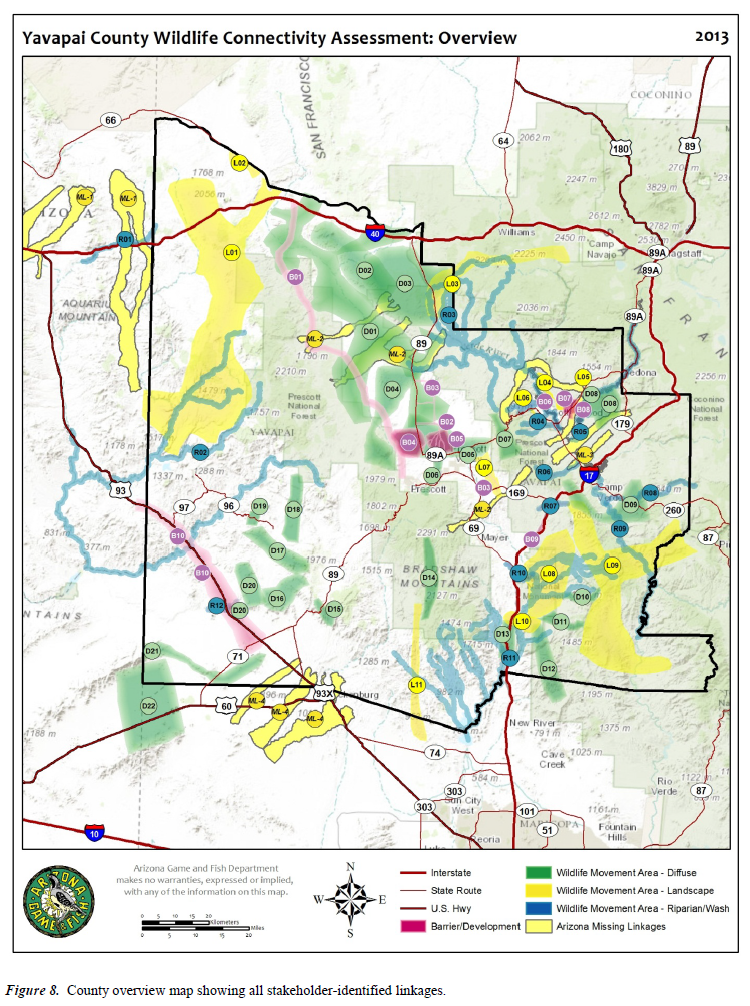
The following three maps illustrate efforts begun in 2006 by multiple Arizona stakeholders to identify potential wildlife connectivity corridors between existing
wildland areas. These proposed linkage zones are used by conservation organizations, such as The Nature Conservancy, to help prioritize outreach for
voluntary conservation easements on private lands or for Northern Arizona Council of Governments to plan road infrastructure with wildlife in mind, for
example. Stakeholder Maps: ADOT (Fig. 1), AZ Fish and Game (Fig. 2), N. Arizona University (Fig. 3)


The Cost: Property, Sovereignty, and the American Dream
Perpetual easements and sustainability mandates reshape the very meaning of ownership. Landowners may receive temporary grants or tax benefits, but they lose long-term autonomy and flexibility. Generational land transfers become complicated, property values are constrained, and local economies are distorted. The broader cost is cultural: the American Dream—rooted in private property, self-reliance, and local governance—is steadily replaced by managed dependency and centralized administrative oversight.
Even when Congress intervenes—as it did with H.J. Res. 104, 105, and 106, overturning Bureau of Land Management plans in Montana, North Dakota, and Alaska—or the Supreme Court ruling on abolishing the Chevron Doctrine (Loper Bright case), the entrenched bureaucratic and NGO systems remain largely unbroken. For decades, Chevron deference had allowed agencies (see Sackett v EPA case, as an example) broad interpretive latitude, often enabling regulatory expansions that indirectly constrained private property rights and weakened the security of ownership.
Such deference stood in tension with John Locke’s view that natural rights—especially the right to acquire, use, and enjoy property—are pre-political and must not be subordinated to administrative convenience. The U.S. Constitution is also clear on this. Over time, the persistence of these unconstitutional mechanisms underscores how deeply institutionalized American land-use governance has become.
The Call to Defend Local Control
We must not stand idly by while our communities are reshaped by planners who do not share our values. Simply voting every 2 years is not enough. Those who would take your freedoms count on this. Guard your Arizona values. Educate yourself, Engage your neighbors. Speak out. Show up. Demand transparency and local control. Make sure your city and county General Plans reflect the enduring principles of faith, family, and freedom—not imported blueprints for soft tyranny disguised as progress.
Yavapai County belongs to you—not to distant organizations, not to outside consultants, and not to ideologies that deny your God-given liberty. As Thomas Paine reminded us, “Those who expect to reap the blessings of freedom must undergo the fatigue of supporting it.”
Let us ensure our plans for the future honor the values that built this community in the first place—self-governance, stewardship rooted in consent, and the freedom to shape our land and destiny without bureaucratic interference.
What You Can Do Right Now! There are several ways to make a difference in your community and much of your engagement depends on what you are willing to give in time and focus. Don’t wait for someone else to pick up the mantle. Look at the following plan for how you can engage and begin your journey, today.
Educate Yourself
Read all six Civic Awareness publications on this topic (https://www.yavgop.org)
Become familiar with the facts behind the issues
Vet your sources of information for truth and accuracy
Collect good sources for reference
Find out how to become a precinct committeeman in your area (https://www.yavgop.org/getinvolved)
Engage With Your Neighbors
Help as many as you can to get up to speed and get involved; numbers are an advantage
Sponsor gatherings to discuss and debate the issues
Invite them to join you at public agency meetings
Engage With Your Elected and Unelected Public Servants
Establish a positive rapport, as much as possible
Learn how your system of government works at all levels but especially locally
Make time to attend any Town Halls, Council or County Meetings, Candidate Meet and Greets
Volunteer for committees and groups, whenever possible
Monitor government legislation and administrative changes
Use Open Access and Freedom of Information (FOIA) processes to gather facts
Communication
Inform your peer groups of upcoming issues and legislative changes
Express your opinions to your elected and unelected public servants
Learn the Arizona RTS system and speak to your state representatives
Citizen Precautions and Language Awareness: How to Engage Effectively
Participating in public comment is one of the most important civic duties in a self-governing community. But doing it effectively, so your input is respected, recorded, and taken seriously requires care in both what you say and how you say it. The following principles can help citizens across Yavapai County and beyond engage with professionalism, credibility, and clarity.
Speak the Language Planners Use
Use professional planning terms rather than ideological or United Nations–based language. This keeps the focus on the substance of your comments and prevents your input from being dismissed as “fringe.”
Instead of referencing Agenda 21 or global sustainability goals, cite local planning concepts such as:
Future Land Use Map
General Plan Consistency
Infrastructure Capacity
Level of Service (LOS)
Trip Generation
Compatibility with Existing Character
Fiscal Impact
Public Safety / EMS Response Times
Water Availability and Stormwater Management
Grounding your language in these terms keeps discussion in a technical, fact-based frame—where it can’t be easily ignored.

Recognize Nuance—Avoid “One Size Fits All” Thinking
Not all Smart Growth ideas or conservation tools are inherently bad. The issue is how and where they are applied. Ask critical questions about scale, density, infrastructure, and long-term impact, especially regarding:
High-density / “affordable” / workforce housing: Demand site-specific analyses on traffic, water, and emergency services.
Transit-oriented villages: Require proof of viable transit demand, operational funding, and safety access.
Agricultural and open-space zoning: Guard against replacing working ranches with eco-tourism ventures that undermine water rights and rural economies, particularly in the Verde Valley.
Conservation easements: Insist on time limits, clear public records, and opt-out or review clauses to protect property flexibility.
Good planning isn’t about rejecting change—it’s about ensuring solutions fit the local context.
Don’t Just Say “No”—Offer Solutions
Effective civic engagement means proposing realistic alternatives. Each proposal should be reviewed on its merits, not ideology. Frame your comments as:
“Modify” rather than “Reject.”
“Condition approval on…” instead of a flat “No.”
Offer specifics:
Adjust density, building height, or phasing.
Require full traffic and water studies before occupancy permits.
Tie projects to existing infrastructure capacity.
Suggest alternative housing types—like cottage courts or ADUs—that suit local conditions.
This approach demonstrates informed participation, not obstructionism.
Get Involved Early with the County Zoning Project
Track General Plan and zoning code timelines monitor progress, don’t wait for final hearings.
Keep others up to date and engaged. Invite your neighbors to join you at these meetings.
Understand Arizona’s Open Meeting Laws. State and local officials are bound by these laws.
Submit written comments during draft stages when your input can still shape the outcome.
Request access to redline edits and staff reports; cite page and section numbers.
Keep a paper trail: ask that your questions and comments be answered on record.
Early, informed involvement ensures your voice is part of the official process, not an afterthought.
Language and Awareness: Reading Between the Lines
Words matter—and in the world of public planning, they are often used strategically. Terms like sustainability, resilience, affordability, equity, livability, or open space sound positive but can mask complex or restrictive policies. Warm and fuzzy terms can conceal permanent changes to property rights, taxation, and land use.
To cut through the fog, ask clarifying questions:
“What specific metrics define sustainability in this plan?”
“How is affordability measured, and for which income levels?”
“Does open space mean accessible parks—or land withdrawn from use under easement?”
Avoid assuming planners or consultants are acting in bad faith. Most believe they serve the public good—but professional bias, institutional incentives, and grant-driven agendas can subtly steer outcomes. Recognize that nudging—the careful framing of choices and definitions—is a standard practice in planning. Also, recognize that when grants are involved, they often come with strings attached. Your task as a citizen is to see it, name it, and keep the conversation anchored in clarity.
Language can also soften regulation. “Guidelines” can morph into enforceable codes, and “voluntary programs” may become mandatory once funding is tied to compliance. Always ask:
Is this policy advisory or regulatory?
Is it temporary or permanent?
Is it locally initiated or federally conditioned?
What are the grant criteria imposing?
Precision in language equals power in participation. When you speak using planning terminology—density bonus, conditional use permit, capital improvement plan, fiscal impact ratio—your input carries professional weight and must be entered into the record.
Above all, stay calm, factual, and clear. Ask for definitions in writing. Request measurable terms in every plan and ordinance. Assume good faith—but verify everything. That balance of vigilance and professionalism is how language becomes a tool of accountability rather than manipulation.
If you have made it this far in the series, congratulations—and thank you for taking the time to engage with an issue that has meaningful implications for the future quality of life in this County. If you missed any installments, you are encouraged to revisit them for additional context.
In a constitutional republican form of government, elected officials govern with the consent of the people. Their authority is derived from the public, and informed participation is essential to that process. Your attention, input, and engagement matter. This is an opportunity to be involved—one that can help shape outcomes. Together, informed citizens can make a difference.
RESOURCES
TERMS & BUZZ WORDS
Sustainable Development
Alternative Housing
Biodiversity
Brownfield Remediation
Carbon Footprints
Carbon Neutral Urbanism
Carbon Reduction Goals
Climate Action Plans
Climate Adaptation
Climate Resilience
Community Visioning
Compact Living
Economic Justice
Environmental Justice
Equity
Gender Diversity
Green New Deal
Green Space
High Density, Mixed Use
Inclusive Communities
Infill Development
Livability
Managed Consensus
Mixed-Use Development
Model Legislation
Resilience
Smart GrowthSocial Engineering
Social Justice
Street Calming
Sustainable Development
Transit Oriented Development
Transportation/Mobility Equity
Underserved Communities
Urban Green Infrastructure
Urban Sprawl
Urgency
Valuing Community Character
Walkable Urbanism
Whole of Government
Wilderness Designation
Wildlife Corridors
Click HERE to access Mary’s
Glossary of Terms.
This glossary is provided for
informational and educational
purposes only. No part may be
reproduced, distributed, or transmitted without
prior written permission.
Contact: marytbaker@proton.me